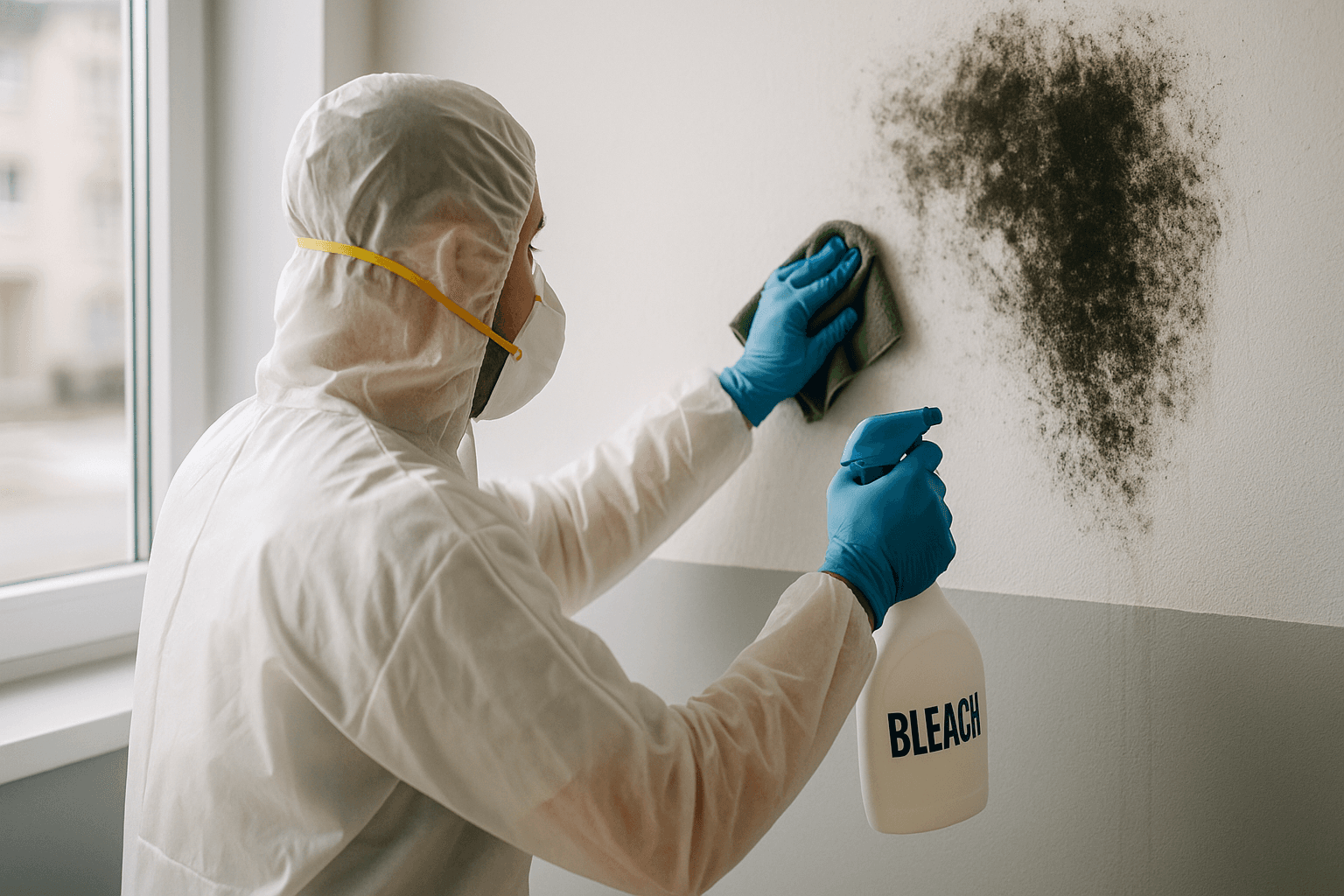
Search any home-improvement forum for black mold and the top advice is the same: spray it with bleach. The advice is wrong. Bleach kills surface mold on hard, non-porous surfaces but does almost nothing on the porous materials where black mold actually grows. The roots survive, the colony regrows in weeks, and you have wasted hours of work plus exposed yourself to spores. This guide explains the chemistry of why bleach fails, what actually works, and when Colorado Springs homeowners should call professional remediation.
Key Takeaways
- Bleach kills surface spores but cannot penetrate porous materials where mold roots live.
- EPA explicitly does NOT recommend bleach for mold remediation on most home surfaces.
- For Stachybotrys (true black mold), professional remediation with containment is the only safe approach.
The Chemistry of Why Bleach Fails on Mold
Sodium hypochlorite (the active ingredient in bleach) is a powerful oxidizer that destroys cell walls of bacteria and surface fungi. On hard, non-porous surfaces — glass, porcelain, sealed metal — bleach kills mold spores effectively.
The problem: black mold colonies grow with hyphae (root structures) that penetrate porous materials — drywall, wood, grout, carpet padding, insulation. The water in bleach soaks into the porous material and feeds the surviving roots. The chlorine dissipates within hours without reaching the deeper hyphae.
Per the EPA Mold Remediation Guide: "The use of a chemical or biocide that kills organisms such as mold (chlorine bleach, for example) is not recommended as a routine practice during mold cleanup."
What Actually Happens When You Bleach Black Mold
Three predictable outcomes:
- Visible bleaching of color: The mold appears to disappear because bleach removes pigment. The colony is still alive.
- Spore release on contact: Disturbing the mold without containment releases millions of spores into your indoor air.
- Regrowth within 2-6 weeks: The water you applied to the porous material feeds the surviving roots. Colony returns, often larger than before.
What Actually Works on Porous Surfaces
For small areas under 10 square feet, EPA-recommended approaches:
- Soap and water on hard, non-porous surfaces. Mechanical removal does most of the work.
- Vinegar (acetic acid) is more effective than bleach on porous materials because it penetrates deeper and reaches root structures.
- Hydrogen peroxide (3%) kills mold on porous surfaces and breaks down to water and oxygen — no toxic residue.
- Borax solution inhibits regrowth by altering pH at the surface.
- For porous materials with significant contamination: Remove and replace. No chemical reliably kills mold deep inside drywall or carpet padding.
When DIY Stops and Professionals Start
EPA guidance defines the threshold:
- Under 10 sq ft of non-toxic species: DIY safe with N95 mask, gloves, ventilation.
- 10-100 sq ft: Professional preferred. Containment and HEPA filtration become important.
- Over 100 sq ft, OR confirmed Stachybotrys (true black mold): Professional remediation required. Full containment, negative air pressure, HEPA scrubbers, antimicrobial treatment, and post-remediation verification.
Why Black Mold Is Especially Dangerous
Stachybotrys chartarum (true black mold) releases mycotoxins that cause:
- Respiratory issues, persistent cough, sinus inflammation
- Headaches and brain fog
- Skin irritation and rashes
- In children and immunocompromised adults: severe respiratory complications
The CDC confirms hidden mold exposure causes documented health effects. Disturbing black mold without proper containment can spike spore concentrations in your home for weeks.
Why Colorado Springs Homes Get Black Mold Despite the Dry Climate
Three local factors create black mold conditions even in our arid climate:
- Snow-melt and ice dams force water into wall cavities every winter.
- Basement humidity climbs above 60% in many homes due to slab moisture.
- Older bathroom ventilation is inadequate in pre-1990 homes — moisture lingers behind tile and grout.
The Right Remediation Process
Professional black mold remediation follows strict steps:
- Air-quality testing to identify species and spore counts.
- Containment with plastic sheeting and negative air pressure.
- HEPA air scrubbers running continuously throughout the project.
- Removal of contaminated porous materials (drywall, insulation, carpet) — not chemical treatment.
- Antimicrobial treatment of substrate and surrounding hard surfaces.
- Address moisture source — the mold returns within months without this.
- Post-remediation verification air testing to confirm spore counts back to baseline.
Frequently Asked Questions
Will bleach work on shower grout?
Partially. Grout is semi-porous; bleach can reach surface mold but rarely reaches roots in deeper grout pockets. Vinegar or hydrogen peroxide work better. For persistent grout mold, regrouting is the real fix.
Is all black-colored mold actually toxic Stachybotrys?
No. Many mold species are dark colored. Cladosporium and Aspergillus niger can both look similar to true black mold. Lab testing identifies the actual species.
How much does professional black mold remediation cost?
$1,500-$3,500 for contained small-area remediation. $5,000-$15,000 for whole-room or whole-bathroom contamination. Whole-house remediation can exceed $30,000.
Does insurance cover black mold remediation?
Only if the mold resulted from a covered water-damage event (burst pipe, appliance failure). Mold from gradual leaks or humidity is excluded. Most policies cap mold coverage at $5,000-$10,000.
When to Call CC Restoration
CC Restoration handles mold remediation in Colorado Springs, Monument, Pueblo, and the Front Range with IICRC-certified containment, HEPA filtration, and post-remediation verification. We test before remediation, document the project, and verify spore counts after.
Search Mold Remediation Near Me or contact us to schedule a free on-site assessment. Bleach is not a black mold solution — it is a delay that costs you more in the end.