Why Mold Is a Serious Concern for Colorado Properties
Many Colorado homeowners assume that the state's dry climate makes mold a low risk. In reality, mold growth is one of the most common secondary damage issues in Colorado homes, particularly after water damage events, during humid summer months, and in properties with poor ventilation or unresolved leaks. Mold spores exist naturally in every indoor environment. What triggers active growth is sustained moisture on organic materials like wood, drywall paper, carpet, and insulation. Once conditions are right, mold colonies can establish within 24 to 48 hours and spread rapidly through wall cavities, flooring systems, and HVAC ductwork. Understanding the warning signs is the first step toward protecting your property, your health, and your investment.
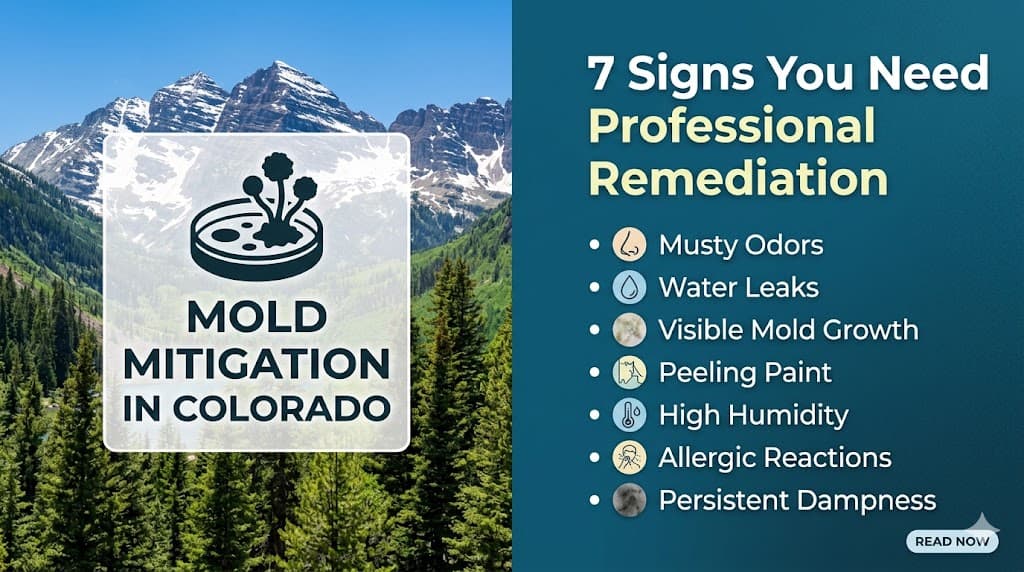
Sign 1: Persistent Musty Odor
A musty, earthy smell that does not go away after cleaning is one of the most reliable indicators of active mold growth. The odor is produced by microbial volatile organic compounds released as mold colonies metabolize organic materials. If you notice this smell in specific rooms, near baseboards, in closets, or when your HVAC system runs, mold is likely growing somewhere nearby, even if you cannot see it. Many homeowners try to mask the odor with air fresheners or deodorizers, but the smell always returns because the source has not been addressed. If the musty smell persists, it is time to investigate further.
Sign 2: Visible Discoloration on Walls or Ceilings
Dark spots, green-black patches, or irregular staining on walls, ceilings, and baseboards are direct visual evidence of mold growth. Mold appears in a wide range of colors including black, green, gray, white, and brown, depending on the species and the material it is growing on. Staining that bleeds through fresh paint, water marks that darken over time, or spots that grow larger week to week all point to active contamination. Do not paint over mold. The growth continues beneath the new coating and the problem worsens.
Sign 3: Bubbling, Peeling, or Warped Surfaces
When moisture collects behind painted surfaces, wallpaper, or laminate, it causes visible distortion. Paint bubbles and peels. Wallpaper lifts at seams. Baseboards and trim warp or pull away from the wall. Vinyl or laminate flooring buckles. These surface changes indicate that moisture has been present long enough to compromise the material underneath, and mold is often found behind these damaged areas when they are opened up during inspection or repair. If you see surface distortion in areas near plumbing, exterior walls, or rooms that previously had water damage, mold growth behind the surface is a strong possibility.
Sign 4: Recurring Allergy Symptoms That Worsen Indoors
Mold exposure triggers immune responses in many people. Common symptoms include persistent nasal congestion, sneezing, watery or itchy eyes, throat irritation, coughing, wheezing, skin rashes, headaches, and fatigue. If these symptoms appear or worsen when you are at home and improve when you leave, indoor mold exposure is a likely contributor. Children, elderly individuals, people with asthma, and those with compromised immune systems are especially susceptible. If multiple household members experience similar symptoms, the likelihood of an indoor air quality issue increases significantly.
Sign 5: Previous Water Damage That Was Not Professionally Dried
If your home experienced a leak, flood, or appliance overflow in the past and the affected area was not dried with professional equipment and verified with moisture meters, residual moisture may still be present in concealed spaces. This is one of the most common origins of mold problems in Colorado homes. A slow roof leak that was patched but never properly dried, a basement that flooded and was cleaned up with towels and fans, or a dishwasher leak that was wiped up without pulling the flooring can all result in mold growth weeks or months later. Professional water and flood damage restoration includes moisture verification that prevents this exact scenario.
Sign 6: Mold That Returns After DIY Cleaning
If you have cleaned visible mold with household products and it comes back within days or weeks, the underlying moisture problem has not been resolved, or the mold has penetrated deeper than the surface you cleaned. Bleach and consumer mold sprays can kill surface mold on non-porous materials, but they do not reach mold rooted in drywall, wood, insulation, or carpet backing. Recurring mold is a clear signal that professional intervention is needed. Certified mold mitigation includes identifying and correcting the moisture source, establishing containment to prevent spore spread, removing contaminated materials safely, and cleaning the surrounding area to reduce recontamination risk.
Sign 7: Mold Growth Covering a Large Area
The EPA recommends professional remediation for mold-affected areas larger than approximately 10 square feet. At this scale, the risk of cross-contamination during cleanup is high, and proper containment barriers, negative air pressure, HEPA filtration, and personal protective equipment are necessary to protect both the occupants and the remediation crew. Large mold colonies also indicate a significant moisture source that needs to be identified and corrected as part of the project. Attempting to handle large-scale mold removal without containment often spreads spores to previously unaffected areas, making the problem worse.
What Does Professional Mold Mitigation Involve?
Certified mold mitigation follows a structured process designed to remove contamination safely and prevent recurrence. The process begins with identifying the moisture source causing the growth. The source must be corrected before remediation can succeed. Next, the affected area is isolated using physical containment barriers and negative air pressure to prevent spores from migrating. Contaminated materials are removed using controlled procedures. Remaining surfaces are cleaned with antimicrobial agents and HEPA-vacuumed. Air scrubbers with HEPA filters run throughout the process to capture airborne spores. Post-remediation verification confirms that moisture levels are within safe limits and the affected area is ready for reconstruction and reoccupancy.
The Connection Between Mold and Other Restoration Services
Mold rarely occurs in isolation. It is almost always connected to a water event, a ventilation deficiency, or deferred maintenance. Properties that have experienced fire damage are also at risk because of the large volumes of water used during suppression. Deep cleaning services may be needed after remediation to address residual contamination on contents, ductwork, and soft goods. In hoarding situations, accumulated materials can trap moisture and create ideal mold conditions, which is why hoarder and estate cleaning projects often include mold assessment as part of the scope.
When to Call CC Restoration for Mold Mitigation
If you notice any of the seven signs described above, or if you have had a recent water event and are concerned about hidden moisture, schedule a professional assessment before the problem grows. Early intervention is always less expensive and less disruptive than waiting until mold has spread through wall cavities, flooring, and HVAC systems. CC Restoration provides mold mitigation services across Colorado, including Colorado Springs, Denver, Pueblo, Boulder, Fort Collins, Aurora, and communities throughout the Front Range.
Our process includes thorough assessment, containment, safe removal, post-remediation cleaning, and moisture-source correction so the problem does not return. Contact us for a professional mold assessment and clear next steps to protect your property and your family's health.